
How to read this guide
Start with the visual assembly above. Each piece maps to a concept in this guide; the sections below provide the engineering detail, rules, examples and evidence needed to implement it correctly.
A retrieval-augmented generation system can retrieve a relevant passage and still produce an incorrect answer. Evaluate the path from source ingestion through retrieval and context assembly to the claims in the final answer.
The fictional Northstar Metrics SDK is an illustrative versioned-documentation assistant, not a real product or customer deployment.
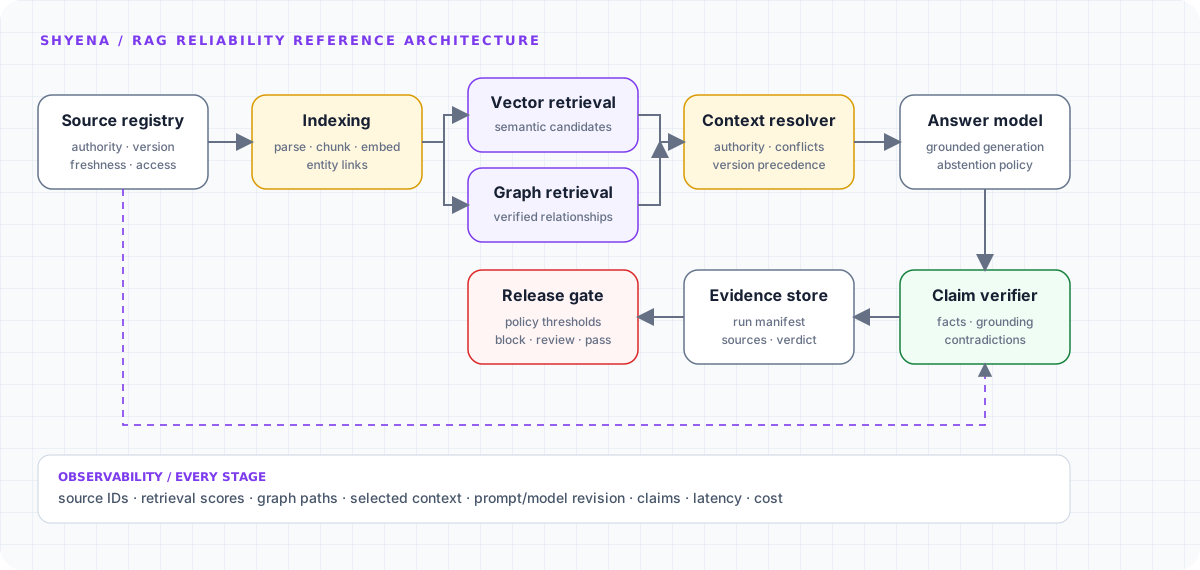
System boundaries
| Layer | Responsibility | Evidence to preserve |
|---|---|---|
| Source registry | Track authority, version, freshness and access | Source ID, revision, metadata |
| Indexing | Parse, chunk, embed and link entities | Index version, chunk IDs, entity links |
| Retrieval | Select passages and traverse relationships | Query, candidates, scores, graph paths |
| Context resolution | Apply authority and version rules | Selected context and conflicts |
| Answer generation | Produce an answer from approved context | Model, prompt revision, raw output |
| Claim verification | Check facts, grounding and contradictions | Claims, source links, assertion results |
| Evidence and gate | Preserve the run and apply policy | Manifest, verdict, policy revision |
Define the contract first
For an SDK v4 question, specify the expected version and parameter, required source, forbidden v3 assumptions and abstention conditions before execution.
case:
  id: sdk-v4-batch-flush
  source_set: northstar-docs-2026-10
  required_facts:
    sdk_version: "v4"
    parameter: "flushIntervalMs"
  fail_if:
    - wrong_version
    - unsupported_claim
    - missing_required_source
    - material_contradiction
The example is fictional. Use deterministic assertions for exact values and semantic evaluation for claim grounding. Review generated test cases before promoting their expected answers to ground truth.
Route failures by evidence
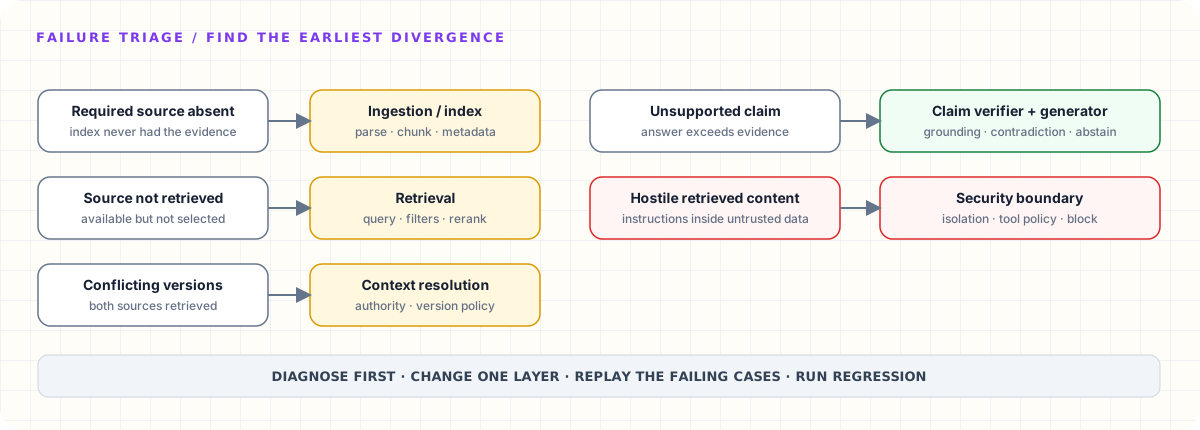
Find the earliest stage where evidence diverges from the contract. Do not change the model first if the correct source never reached context; do not tune retrieval if the evidence is present but the answer contradicts it.
Evaluate independently
- Answer correctness, including version and entity.
- Evidence coverage and retrieval quality.
- Claim-level grounding and contradiction detection.
- Conflict resolution and abstention.
- Security invariants against untrusted retrieved content.
- Latency, cost and evidence completeness.
Do not collapse these into one score. A high average must not override a critical unsupported claim or security failure.
Compare configurations fairly
Compare vector, graph and hybrid retrieval with the same benchmark, source snapshot, generation model and evaluation rules. Change one dimension at a time, preserve the retrieved context, repeat stochastic runs where needed and report by query class. Let evidence—not architecture labels—decide.
Example release policy
release_policy:
  critical_unsupported_claims: 0
  wrong_version_answers: 0
  security_invariant_failures: 0
  required_evidence_complete: true
  human_review_for_policy_changes: true
This is illustrative, not a measured Shyena result. Set and version thresholds according to product risk.
Validate the Shyena website
These commands validate and build the website content; they do not run a RAG benchmark:
npm install
npm run content:validate
npm run content:generate
npm run build
Source note
The public Graph-RAG versus standard RAG experiment is a limited synthetic experiment. Its numeric-string matching metric does not prove claim-level grounding or a universal architecture ranking. This guide uses the source only for that methodological context and presents an independent design.