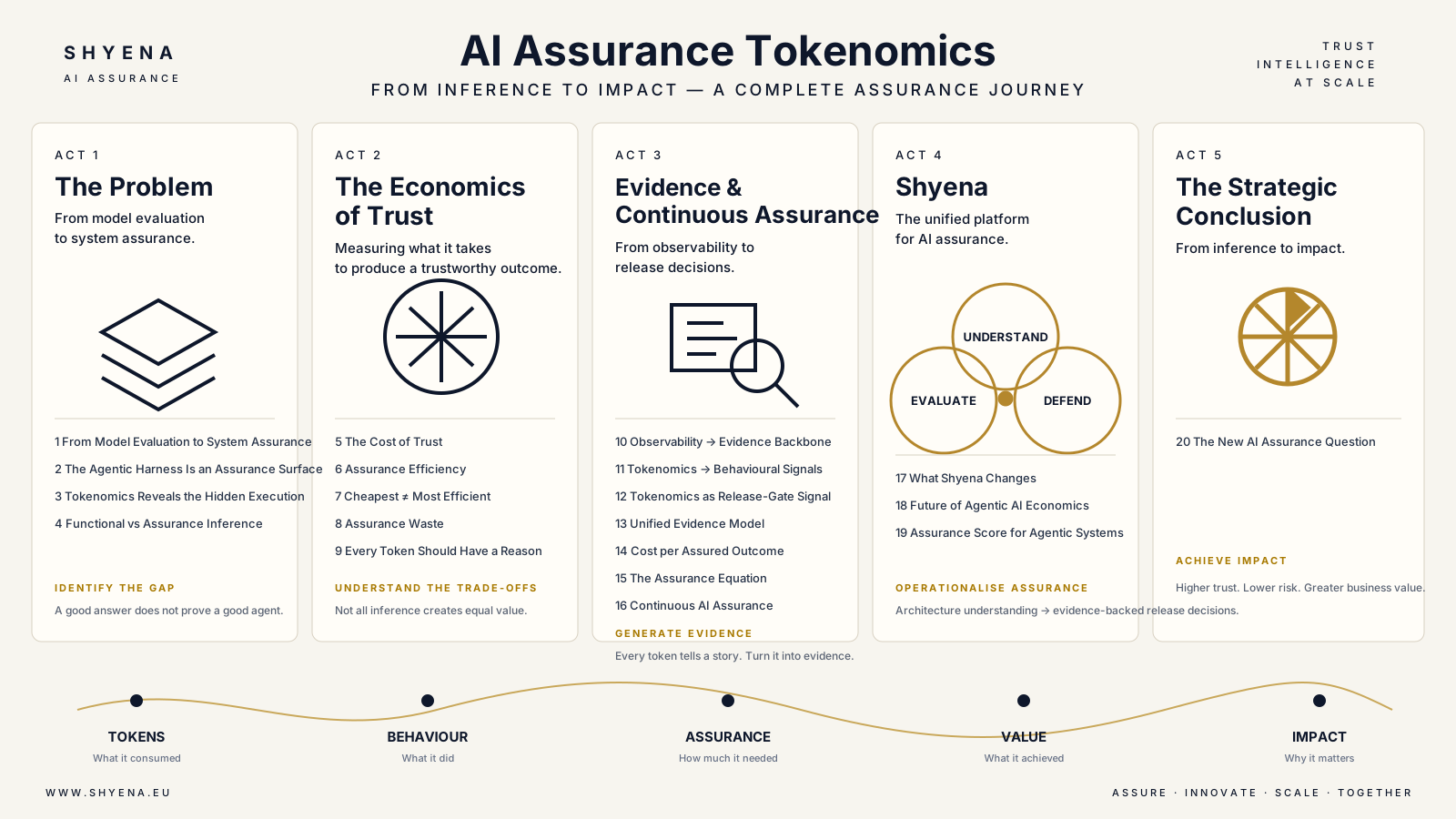
ACT 1 — The Problem
Agentic AI is changing the economics of enterprise software. An AI agent no longer simply receives an instruction and generates a response. It can reason, retrieve information, invoke tools, access memory, interact with other agents, apply policies, evaluate its own output, retry failed operations and ultimately take action on behalf of a user or organization.
The next frontier of AI assurance is not just proving that an agent works. It is proving that it works safely, reliably, efficiently and within an economically sustainable assurance envelope.
1. From Model Evaluation to System Assurance
Traditional AI evaluation largely revolves around the model: input, model, response and evaluation. Agentic AI changes the system boundary. The model is now one component within a larger socio-technical system.
A production assurance programme must therefore evaluate system behaviour, not simply the generated response. Correctness, grounding, safety, security, reliability, governance, privacy and economics all become part of the assurance surface.
2. The Agentic Harness Is an Assurance Surface
The harness determines how an AI system operates around its underlying models. It controls orchestration, context, memory, tools, routing, guardrails, evaluations, retries, human intervention and observability.
Two agents using the same underlying model can behave very differently because their harnesses are different. The harness is therefore something to assure, not merely infrastructure around the model.
3. Tokenomics Reveals the Hidden Execution
For agentic systems, model cost is only one part of execution. Reasoning, planning, memory, retrieval, guardrails, evaluations, reflection, tool interactions, retries, context management and inter-agent communication can all create additional inference activity.
The important assurance question is not only “How many tokens did we consume?” but “Why did we consume them?” Token consumption becomes a signal about architecture and behaviour.
4. Functional vs Assurance Inference
Functional inference directly contributes to the business objective: understanding intent, planning, generating content, selecting actions and executing agent responsibilities.
Assurance inference supports confidence and control: guardrails, evaluations, reflection, policy interpretation, safety classification, memory validation and quality checks. A third category is waste: redundant retries, duplicate retrieval, looping or computation that does not materially improve the outcome or its assurance.
ACT 2 — The Economics of Trust
Traditional FinOps asks how much an AI system costs. AI assurance adds a harder question: how much does it cost to make the system trustworthy?
Functional inference
Computation directly producing the business outcome.
Assurance inference
Computation that increases safety, quality, reliability or control.
Assurance waste
Computation with little or no measurable assurance or business value.
5. The Cost of Trust
Adding evaluations, memory checks and guardrails can increase execution cost while improving outcomes. The right question is therefore not whether assurance adds cost, but whether the additional assurance creates enough value or risk reduction to justify that cost.
6. Assurance Efficiency
Assurance efficiency measures how effectively an AI system converts execution resources into trustworthy outcomes.
A trustworthy outcome is more than a successful response. It should satisfy the required correctness, safety, security, policy, reliability and grounding conditions.
7. The Cheapest Agent Is Not Necessarily the Most Efficient
Suppose Agent A achieves 92% business success at €0.18 per journey while Agent B achieves 97% at €0.91. Agent B is more capable, but the correct decision depends on the value of the additional 5% and the risk associated with failure.
AI economics therefore need to be evaluated alongside quality, safety, security, reliability and business value. The cheapest model is not necessarily the cheapest agent.
8. Assurance Waste
Not every additional LLM call improves assurance. Redundant evaluations, excessive context, repeated tool calls, ineffective guardrails and retries can consume inference without creating proportional value.
A mature assurance platform should distinguish necessary assurance from excessive or ineffective assurance.
9. Every Token Should Have a Reason
Every significant unit of inference should have an attributable purpose: intent classification, planning, knowledge synthesis, security evaluation, response quality evaluation or final response generation.
This makes cost explainable, but more importantly it makes behaviour explainable. Attribution turns tokenomics into assurance evidence.
ACT 3 — Evidence & Continuous Assurance
Once tokenomics is connected to execution traces, it becomes part of the evidence chain. Observability tells us what happened; evaluation tells us whether it was acceptable; assurance determines whether there is enough evidence to trust the system.
10. Observability Becomes the Evidence Backbone
A complete trace should connect the business journey to the agent, model, prompt and context, memory, retrieval, tools, guardrails, evaluations, retries, final response and business outcome. The same execution trace should support quality, security, reliability and economic analysis.
11. Tokenomics Can Reveal Behavioural Problems
A sudden increase in LLM calls per journey can indicate changed orchestration, prompt expansion, retrieval degradation, memory loops, tool failures, guardrail triggering, evaluation loops or model fallback.
Token usage can therefore become an early-warning signal for behavioural drift.
12. Tokenomics as a Release-Gate Signal
Economics can become a release-gate signal. A release might improve semantic quality and security while increasing cost per journey by 72%. Whether that is acceptable should be an explicit engineering decision rather than an accidental production discovery.
13. A Unified Evidence Model
The strongest architecture connects quality, safety, security, reliability, governance, grounding and economics through a shared execution trace and evidence graph.
14. From Cost per Token to Cost per Assured Business Outcome
Cost per million tokens is useful for capacity planning, but the more strategic metric is cost per assured outcome.
An architecture that spends more but produces substantially more trustworthy outcomes can be more economically efficient than a cheaper architecture.
15. The Assurance Equation
AI assurance is multi-dimensional. The objective is not to maximize one score, but to demonstrate that the AI system achieves the intended outcome within an acceptable risk and economic envelope.
16. AI Assurance Becomes Continuous
Models, prompts, knowledge, retrieval, tools, policies, memory and orchestration can change independently. Assurance must therefore continue after deployment.
ACT 4 — Shyena
AI Assurance Tokenomics should not become another isolated FinOps dashboard. It should be a dimension of system assurance, connected to the same execution evidence used for quality, safety, security and reliability.
Understand
Understand the system, orchestration, dependencies and execution path.
Evaluate
Evaluate real journeys, behaviour, grounding, outcomes and efficiency.
Defend
Test security boundaries, adversarial behaviour, policy and unsafe actions.
17. What Shyena Changes
Shyena connects system understanding, execution tracing, behavioural evaluation, security testing, economic measurement, evidence collection, business-risk assessment and release confidence into one assurance chain.
18. The Future of Agentic AI Economics
As organizations deploy multiple agents capable of performing similar tasks, agent selection can become a risk-adjusted economic decision. The best agent may not be the smartest, fastest or cheapest; it may provide the best combination of quality, safety, security, reliability, latency and cost.
19. Toward an Assurance Score for Agentic Systems
An agent assurance profile can summarize quality, grounding, security, safety, reliability, orchestration, governance, cost efficiency and assurance efficiency.
The score must never replace evidence. It is a compact representation of evidence that should remain traceable to the underlying execution.
ACT 5 — The Strategic Conclusion
20. The New AI Assurance Question
The industry began by asking whether a model can generate a good answer. It moved to whether an agent can complete a task. The next question is whether the entire AI system can demonstrate that it achieved the intended business outcome safely, securely, reliably and within defined economic and risk boundaries.
Do we have sufficient evidence to trust this AI system to operate in the real world?
That is the purpose of AI Assurance.
From tokens to trust
The cost of intelligence is becoming the cost of assurance.
Every memory retrieval, evaluation, guardrail, reasoning step, tool call and retry tells part of the story. Shyena turns that execution story into evidence for trustworthy AI decisions.